You built a website. You paid for it. And when you type your business name into Google, your competitor shows up and you don't. It's maddening, and it's the most common complaint we hear from Adelaide small business owners.
The good news: most of the reasons this happens are fixable, often for free. The bad news: "it just takes time" is a real answer, and anyone promising first-page rankings in two weeks is not being honest with you. Here's the unvarnished list of what's actually going on — and what actually moves the needle.
Reason 1: Google has never indexed your site
This is the most common one, and the least understood. Google doesn't automatically know your website exists. It has to find it, crawl it, and add it to its index before it can appear in any search. If you've never actively told Google about your site, it might simply not be in there yet.
| Stage | What Google Does | What It Means for You |
|---|---|---|
| 1. Crawling | Googlebot discovers your URL and fetches the page's code and assets. | Google knows your page exists, but hasn't analysed or filed it into search yet. |
| 2. Indexing | Google parses, renders, and stores your page in its central searchable database. | Your page is officially in Google's library and eligible to appear for search queries. |
| 3. Ranking | Google's algorithms evaluate indexed pages against hundreds of ranking signals. | Determines where you show up: top of page 1, or buried back on page 6. |
Three specific things commonly block indexing:
- A noindex tag left on — many page builders add `noindex` while the site is "under construction" and forget to remove it at launch. Right-click your page and view source: if you see
<meta name="robots" content="noindex">, that's the problem in black and white. - Robots blocked — a
robots.txtrule or a plugin setting telling Google to stay out. - No sitemap submitted — Google has no map of which pages matter, so it might crawl your homepage and give up.
The fix: Submit your sitemap in Google Search Console. If you don't have a sitemap file, that alone tells you your site was never set up for SEO properly.
Reason 2: Your site is too slow for Google
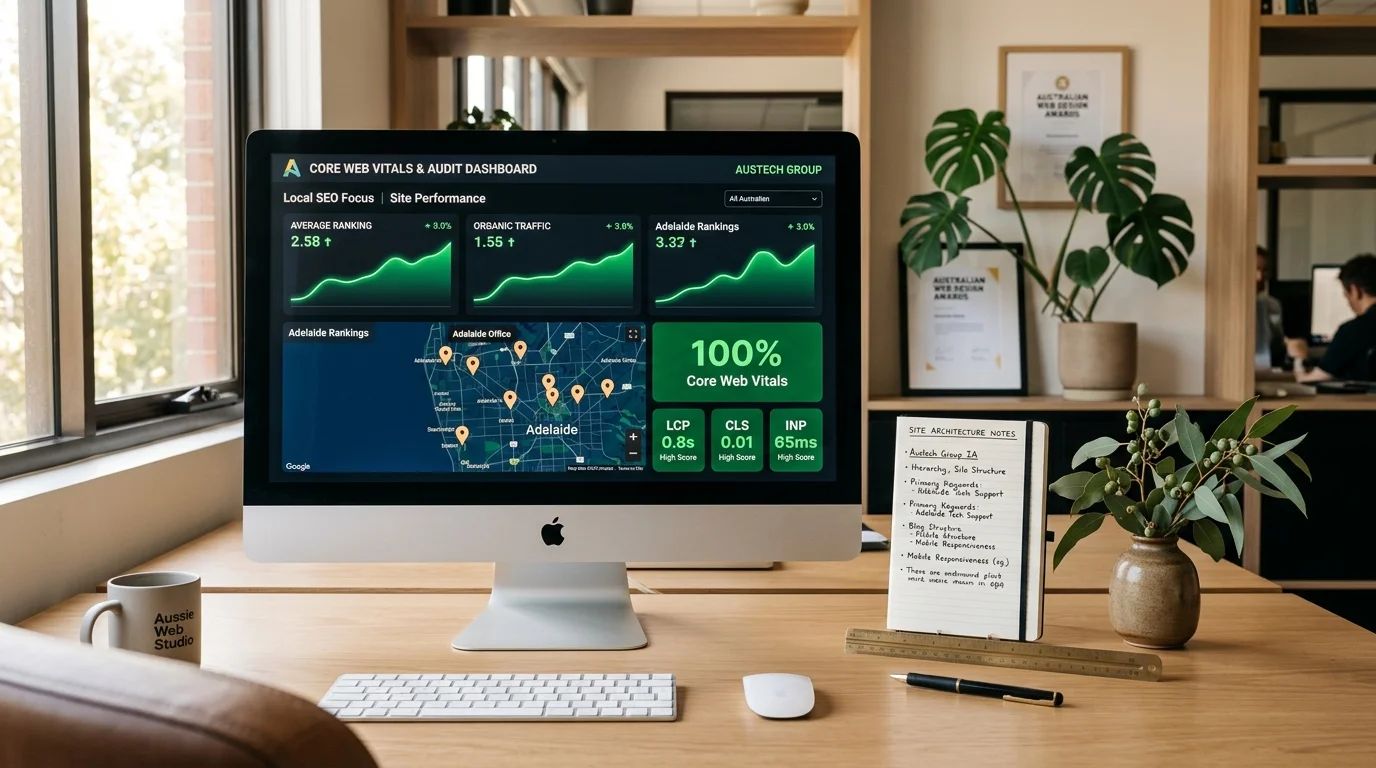
Speed is a real ranking factor — Google calls it "Core Web Vitals" and it measures how fast your page loads and how quickly it responds to a tap or click. But here's the honest nuance: speed isn't magic. A fast site won't rank a thin, useless page. What it does is stop a good site from being quietly held back.
Where speed really bites is on a phone. Builders like Wix, Squarespace and WordPress-with-Elementor drag in huge amounts of code your page never uses. On a phone with patchy signal — which is where half your Adelaide customers are browsing — your site is competing against faster sites in the same search, and a 3-second gap is genuinely the difference between a customer and a bounce. Roughly half of mobile visitors leave if a page takes longer than three seconds to load.
"Speed alone won't rank a thin page, but a slow site will quietly hold back a good one."
We hand-code sites specifically because they ship fewer bytes and load faster — around 0.3 to 0.8 seconds versus 2 to 5 seconds for a typical page-builder site. That's one honest factor in the picture, not the whole story.
Reason 3: Thin content
Google ranks pages that actually answer a search. If your pages have two sentences and a picture, Google has almost nothing to match against a query like "electrician Adelaide" or "where to buy handmade candles South Australia."
Thin means:
- Pages that are mostly images with almost no text
- Copy copied from a template (Google is very good at spotting duplicate content)
- A single-page site trying to cover services, about, and contact in one scroll
- Content rewritten for keywords instead of for real people reading it
The fix: Write genuinely useful copy for each page — enough detail that a real person leaves knowing what you do, who it's for, and what it costs. That serves visitors and gives Google something real to rank.
Reason 4: No local SEO signals
For an Adelaide business, local search is where the money is — "plumber near me," "cafe North Adelaide," "bookkeeper Prospect." If you're missing the local signals, Google has no reason to show you for those searches.
The big three:
- Google Business Profile — not set up, or set up but unverified. This is the single most important local signal for a business that wants people nearby.
- Consistent NAP — your name, address and phone number must match exactly across your website, Google Business Profile, and every directory. "Adelaide Plumbers Pty Ltd" and "Adelaide Plumber" count as two different businesses to Google.
- Local landing pages — if you serve multiple suburbs, a page per area ("drywall contractor in Campbelltown," "in Burnside") helps you show up for each.
The fix: Claim and verify your Google Business Profile, make your name-address-phone identical everywhere, and add genuine reviews. Reviews are real social proof — and you should never buy or fake them.
Reason 5: No backlinks
Backlinks — other sites linking to yours — are still one of Google's big trust signals. If nobody links to you, Google treats you as unproven and ranks you lower, especially against established competitors.
You don't need hundreds. For a local business, a handful of honest links does most of the work: local business directories, your industry association, community pages, perhaps a local news mention. The ones to avoid are paid link farms and "everyone who pays us gets 500 backlinks" packages — Google is very good at spotting those, and they can hurt more than help.
Reason 6: Your domain is new — and time is real
Here's the part we can't shortcut for you: a brand-new domain takes time. Even with everything done right, Google crawls, evaluates and re-evaluates over weeks. A realistic picture for a new Adelaide small-business site:
| Stage | Typical timing |
|---|---|
| First indexed (found on Google) | Days to a few weeks, after you submit the sitemap |
| Ranking for your exact business name | Weeks to a month |
| Meaningful traffic for your searched terms | 3 to 6 months |
Anyone who promises first-page ranking in two weeks for competitive keywords is selling something that doesn't exist. It's weeks, not days — and usually months before you see real numbers. That's not failure; that's how Google works for everyone.
Reason 7: You're optimising for exact-match search
"But I searched 'web designer Adelaide' and didn't find myself!" That's because people don't actually search that exact phrase most of the time. They type things like "who can fix my gutters today," "cake shop open Sunday near me," or "accountant for a small cafe." These are longer, conversational searches, and if your copy just repeats the same two keywords over and over, you've built a site for a search nobody performs.
The fix: write naturally, cover the questions your customers actually ask, and use the words they'd use to describe the problem they have — not the label you'd give your own service.
The free quick wins, in order
If you do nothing else, do these. All free, all doable this weekend:
- Verify your site in Google Search Console and request indexing (free, ~20 minutes)
- Submit your sitemap.xml and ask Google to crawl key service pages
- Check there is no accidental noindex tag or robots.txt block
- Confirm your title tags and meta descriptions actually exist and describe each page
- Claim, verify and optimize your Google Business Profile — essential for Adelaide local search
- Make your NAP (name, address, phone) 100% identical across your website and directories
- Test your speed on a phone and fix slow images (aim for < 1.5s mobile load time)
- Add schema markup (LocalBusiness or Service) so AI search engines understand your entity
Do those seven and you'll be ahead of most small business sites in Adelaide. Then — and only then — hand it time. Consistency beats perfection. Post consistently, get a few honest reviews and backlinks, and improve one thing at a time. That's what actually moves Google.
The honest ending
If this all sounds like a lot of small, unglamorous jobs — that's because SEO is. There's no single switch. But the good news is that a properly built, properly set-up site compounds. The site that loads fast, ranks a bit, and gets a few reviews this month is worth more than the one that only looked good in the mockup.
Through our SEO and discovery service, we're happy to run a quick, free check of your site and tell you plainly what's blocking it from Google — including when it's nothing we can fix and you just need to wait. No jargon, no magic promises.
Frequently Asked Questions
How long does it take for a new website to show on Google?
For a brand-new domain with no backlinks, it usually takes a few weeks to a few months to start appearing in results, and meaningful traffic can take three to six months. Google crawls and re-crawls over time; even with everything done right, ranking is a gradual process, not overnight. Anyone promising first-page rankings in two weeks is not being honest.
Why isn't my website showing up when I search my business name?
Most likely because either the site isn't indexed yet, a noindex tag or robots rule is blocking Google, or you have no Google Business Profile (or an unverified one). Search for a word from the middle of your homepage text with your suburb and see what comes up. If nothing does, submit your sitemap in Google Search Console.
Does website speed really affect Google rankings?
Yes, but it's one factor among many, not magic. Google measures Core Web Vitals like loading speed and interaction delays. A fast site gets slightly ahead and, more importantly, doesn't get penalised by slow-loading bloat. Speed alone won't rank a thin page, but a slow site will quietly hold back a good one.
Why does my site rank for some words but not the ones I want?
Because people rarely search the exact phrase you'd write in a headline. They search 'plumber near me', 'electrician urgent Adelaide' or 'handyman who does decks', which are longer, conversational phrases. If your copy repeats the same keyword over and over, you're optimising for exact-match search that barely exists. Write for how people actually ask questions.
What's the fastest free thing I can do to help my site appear on Google?
Verify your site in Google Search Console and submit your sitemap. That actively tells Google your pages exist and asks it to crawl them. It's free, takes about 20 minutes, and it's the single most direct first step for a site that hasn't been indexed yet. Also make sure there's no noindex tag and that your robots.txt isn't blocking Google.
Do I need backlinks to rank for local searches?
Backlinks help but they're not the only thing. For local searches, consistent Google Business Profile details, matching name-address-phone across directories, local landing pages and genuine customer reviews matter at least as much. A handful of honest backlinks from local business directories and community pages is usually enough for a small local service business.