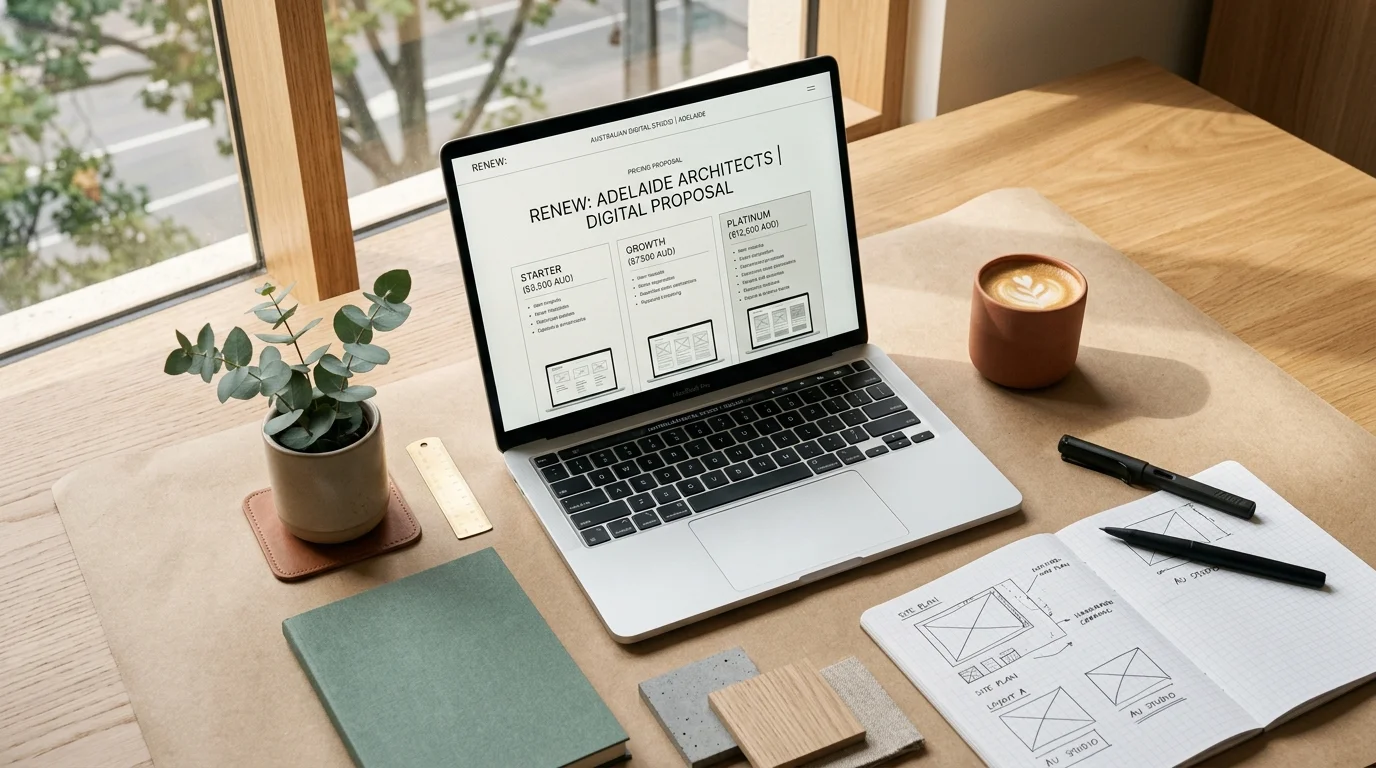

If you have recently asked for website quotes in Adelaide, you have likely encountered significant price variance. One proposal might come back at $800 from a sole freelancer, another sits at $2,500, and an established digital agency might quote $12,000 for what seems like the exact same five-page business website.
Comparing these proposals is genuinely difficult because the line items often use different jargon. Two proposals might look similar in a static PDF mockup, but the underlying scope, technology, asset ownership, copywriting responsibilities, hosting agreements, and post-launch support can be entirely different products.
The objective of this guide is not to steer you toward the cheapest quote or to recommend any single agency model. The objective is to give you a clear, objective framework so you know exactly what questions to ask, what you are purchasing, and how to de-risk your investment before signing a contract or paying a deposit.
1. Start With What the Website Needs to Do
Before comparing external designers, vendors, or platforms, evaluate what the website actually needs to accomplish for your business operations. Web designers often pitch tools, frameworks, and visual aesthetics, but a business website is primarily a communication and operational tool.
Consider which of the following operational functions are essential on day one versus nice-to-have later:
- Enquiry handling: Does the site need a reliable form that routes customer details to a primary email inbox without failing or hitting spam filters?
- Service qualification: Does your copy need to explain your service areas, project minimums, and capabilities so you spend less time answering unsuitable calls?
- Instant quoting or estimations: Would a structured interactive calculator help filter high-intent prospects before they reach your team?
- Self-service bookings: Do clients need to book consultations directly into your calendar software (e.g. Calendly, Timely, or ServiceM8)?
- Payment processing: Do you need to collect invoice deposits, credit card payments, or subscription fees via Stripe?
- Local credibility: Does the site need to showcase genuine South Australian licensing, customer reviews, and completed project photography?
When you have a concise list of what the site must do, you can assess proposals based on whether they solve those operational requirements rather than whether their visual presentation is merely polished.
2. Compare Scope, Not Just Price
A price tag without a detailed scope of work is meaningless. When a quote states "5-Page Custom Website — $2,000", that statement leaves crucial questions unanswered. A professional, transparent proposal defines scope boundaries clearly so both parties share identical expectations.
When reviewing proposals, compare how each vendor addresses these fundamental deliverables:
| Scope Area | Vague Proposal (High Risk) | Thorough Proposal (Clear Scope) |
|---|---|---|
| Page Structure | "Up to 5 pages included" | Specific sitemap defined (Home, About, 2 Core Services, Contact). |
| Copywriting | "Client to supply all content" | Clarifies whether text is written from scratch, edited from client notes, or pasted as-is. |
| Mobile Layouts | "Mobile responsive" | Tailored mobile hierarchy, thumb ergonomics, tap-to-call buttons, and responsive breakpoints tested. |
| SEO Foundations | "SEO included" | Explicit deliverables: title tags, meta descriptions, sitemap.xml, robots.txt, schema markup, and Search Console setup. |
| Forms & Testing | "Contact form provided" | Enquiry routing, anti-spam protections (hCaptcha/honeypots), notification autoresponders, and delivery testing. |
| Revisions | "Reasonable revisions" | Specified review rounds (e.g. 2 structured review cycles prior to code sign-off). |
For a realistic breakdown of typical market price brackets across South Australia, read our companion analysis on how much a website costs in Adelaide.
3. Ask Who Owns the Domain
Your domain name (e.g. yourbusiness.com.au) is the primary digital property of your company. It carries your brand reputation, search authority, email routing, and customer trust. Misunderstandings surrounding domain ownership remain one of the most frequent administrative issues Australian small businesses encounter.
There is a fundamental difference between a designer configuring your domain and a designer registering it under their own account:
The practical standard: Your business should always be the registered holder of the domain on the official registrar record (such as auDA for .com.au domains, requiring your genuine ABN). Furthermore, the primary account login with the domain registrar should belong to your business email address. If a designer needs to configure DNS records (to point the website to a server or set up Google Workspace email), they can be granted delegated technical access. They do not need to purchase the domain in their own name or control the master account.
"Your business should know who the registered domain holder is, who has account access, and how the domain can be transferred if the relationship ends."
4. Ask Who Owns the Website and Source Files
Ownership and access are distinct concepts. You can have administrative access to edit text in a content management system without legally or practically owning the underlying source code and design files.
Ask prospective web designers to clarify intellectual property and handover terms in writing before project commencement:
- Production code: Upon final invoice payment, does your business own the website code outright? Can you download the complete file package and host it on any standard server?
- Proprietary CMS lock-in: Is the website built on an open standard, or does it require the designer's closed-source proprietary platform to function? If you cancel your agreement, does the website cease operating?
- Design files and graphics: Are original Figma designs, custom brand vector assets, and typography files delivered at handover?
- Third-party asset licences: If commercial stock photography, video clips, or custom web fonts are purchased during the build, who holds the permanent licence?
Understanding these handover arrangements upfront ensures that you maintain complete operational sovereignty over your digital headquarters as your business scales.
5. Understand Hosting Before You Sign
Every website must live on a web server connected to the internet. Web hosting arrangements fall broadly into two categories, both of which have valid commercial tradeoffs:
Option A: Direct Business-Owned Hosting
In this model, your business opens an account with an established hosting provider (such as Cloudflare Pages, AWS, Netlify, or standard Australian cPanel providers) and pays the host directly. The web designer deploys the files to your server account.
- Pros: Complete independence. You hold the master billing credentials. If your designer relocates or changes careers, your website remains live and fully accessible.
- Cons: You are responsible for monitoring hosting renewals and managing billing details.
Option B: Agency-Managed Hosting
In this model, the design agency hosts your website on their infrastructure and invoices you an ongoing monthly or annual fee. This fee frequently bundles server space, automated backups, security certificates (SSL), and regular software updates.
- Pros: Hands-off convenience. The agency handles technical server issues, configuration, and security monitoring.
- Cons: Potential lock-in. If the agency raises rates significantly, or if communication breaks down, migrating away can require technical coordination.
Neither model is inherently right or wrong. The crucial requirement is that the proposal makes the hosting arrangement explicit: what it costs per month, what services are included, and what the migration process entails should you choose to change providers in the future.
6. Look at the Technology, But Don't Choose on Tech Alone
Web designers often have strong personal preferences for specific development stacks: WordPress, Webflow, Shopify, Squarespace, Wix, or custom hand-coded static sites. While technical architecture matters immensely for performance and security, your choice should align with your business model rather than a vendor's habit.
Consider the practical operational differences:
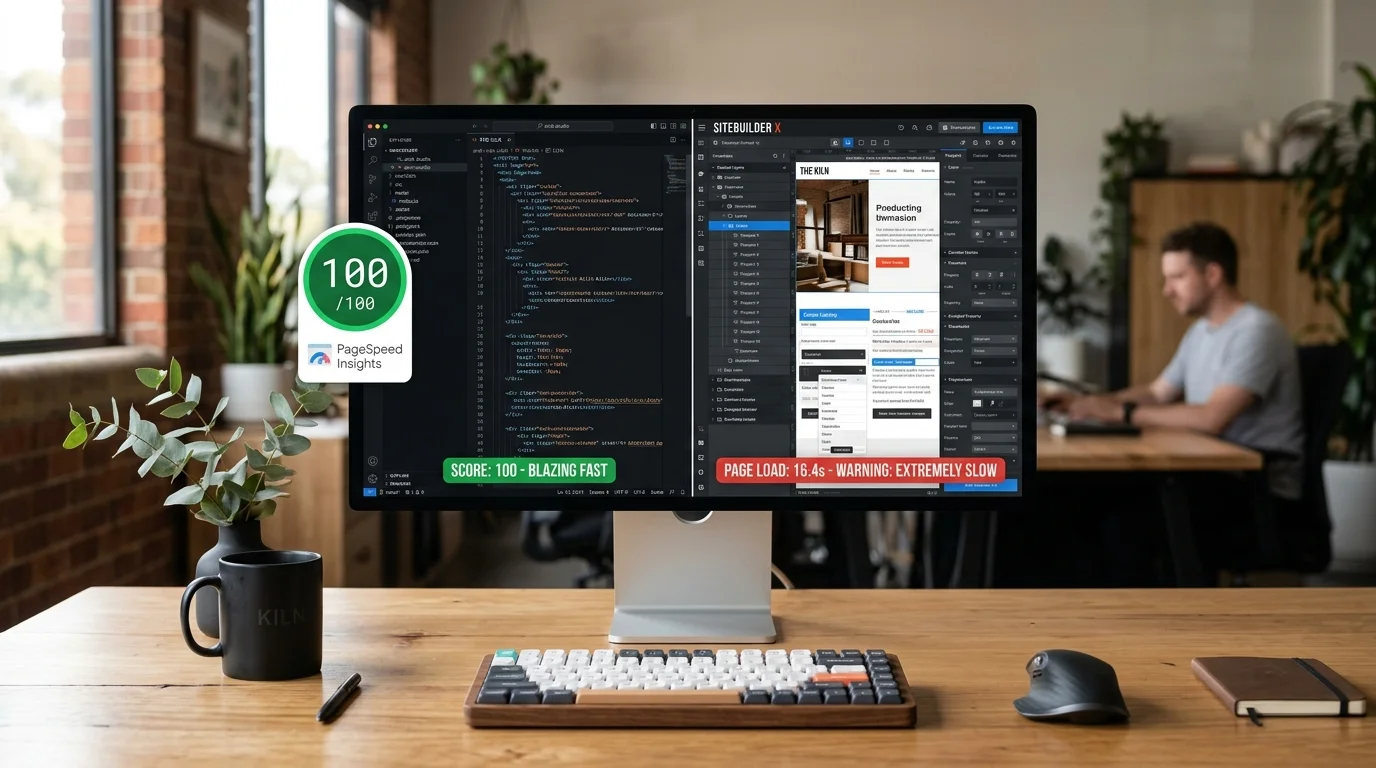
- Hand-coded static architecture: Code written directly in clean HTML, CSS, and modern JavaScript. Because there is no database running on every visit, these sites achieve near-instant load speeds (scoring 95–100 on Google PageSpeed), require zero ongoing security plugin updates, and cannot be compromised via CMS database exploits. For 5 to 15-page service businesses, they provide superior longevity and minimal maintenance. We break this down in detail in our comparison of hand-coded vs page builders.
- Content Management Systems (CMS): Platforms like WordPress or Webflow. These are well-suited if your staff need to publish fresh blog content multiple times per week or manage complex dynamic databases. However, WordPress sites require diligent maintenance, regular plugin patching, and caching configuration to avoid performance degradation.
- Hosted builders (Wix / Squarespace): Fast to launch for micro-businesses, but carry ongoing monthly platform subscription fees, code bloat that can impact Core Web Vitals, and structural lock-in.
Ask your designer why they recommend their specific stack for your exact business requirements, and how that choice affects your total cost of ownership over three to five years.
7. Ask What Happens After Launch
The day a website launches is not the end of the project; it is the beginning of its operational life. A reliable proposal defines post-launch support with the same precision as upfront design.
Specifically clarify:
- Warranty period: Is there a complimentary bug-fix warranty after launch? (For example, a 30-day window during which any broken links, form delivery issues, or display anomalies are corrected at no additional charge).
- Maintenance requirements: Does the technology require weekly or monthly software patches? If yes, who performs them, what does that cost, and what happens if an update breaks a layout?
- Content editing: How do you update basic details like your phone number, staff profiles, or pricing? Are you provided with clear documentation or a video walkthrough?
- Support rates: If you want to add a new service page six months after launch, is that billed on an ad-hoc hourly rate, or via a pre-scoped fixed quote?
8. Check the Contract and Quote Carefully
A legitimate web design project should be governed by a written proposal or service agreement. You do not need an adversarial legal document, but you do need an agreement that clearly outlines mutual responsibilities.
Look for clarity regarding these standard contractual terms:
- Payment milestones: A standard Australian industry practice is a staged deposit model (e.g. 50% upfront deposit, 50% upon final deployment after sign-off). Beware of vendors demanding 100% upfront payment for multi-month projects without clear staging milestones.
- Timeline assumptions: What are the estimated milestones, and what client inputs (branding assets, copy approval) are required to maintain the schedule?
- Exclusions: Does the quote explicitly state what is not included? (e.g. professional photography, custom CRM API integrations, paid font licences, ongoing Google Ads management).
- GST clarity: Is the quoted figure inclusive or exclusive of GST? For Australian businesses, an unexpected 10% GST addition on an invoice can disrupt cash-flow planning if not clarified upfront.
Note: This advice is general operational guidance and does not constitute legal counsel. For complex commercial arrangements or high-value enterprise contracts, independent legal advice is recommended.
9. Verify the Business You're Hiring
Whether you choose an individual Adelaide freelancer, a boutique design studio, or a mid-sized digital agency, basic due diligence helps ensure you are engaging an accountable commercial entity.
Take these practical verification steps:
- Check the Australian Business Register (ABR): Verify that the provider has an active Australian Business Number (ABN) or Australian Company Number (ACN). You can conduct a free, instant search on
abr.business.gov.auto confirm their trading history and GST registration status. - Inspect live client websites: Do not rely solely on screenshot mockups in a PDF portfolio. Request links to actual, live websites the designer has built. Open them on your mobile phone, click through the pages, test form loading, and evaluate how quickly they respond.
- Check communication transparency: Does the business provide clear contact avenues, responsive communication, and transparent consultation processes?
10. Warning Signs That Deserve Questions
Encountering one of these items does not automatically mean a service provider is dishonest, but each represents an unnecessary commercial risk that warrants a direct conversation:
- Guaranteed #1 rankings on Google: No web designer or SEO provider can guarantee a first-page or #1 ranking on Google. Google's ranking algorithms evaluate hundreds of factors, and promising guaranteed rankings is a recognized red flag across the search industry.
- Refusal to provide code or server access: If a designer indicates that you can never access your site's files or move to another host, you are entering a closed proprietary ecosystem.
- Vague "all-inclusive" quotes with no written scope: A one-line quote saying "Complete Website — $1,500" almost always leads to scope disputes mid-project when you ask about content, SEO, or form handling.
- Hidden mandatory subscriptions: Discovering after launch that your website requires $80/month in mandatory proprietary plugin licences simply to display forms or galleries. For a deeper analysis of these recurring expenses, see our guide on why cheap websites cost more in the long run.
11. Adelaide Web Designer Comparison Checklist
Use this reference checklist when comparing proposals from different Adelaide web design studios or freelancers:
| Vetting Criterion | Preferred Standard | Questions to Ask |
|---|---|---|
| Domain Control | Business is registered holder; primary credentials held internally. | "Will our company hold master ownership of our domain registration account?" |
| Code & Asset Ownership | 100% client ownership transferred upon final payment. | "Do we own all custom code, design files, and written assets outright upon project completion?" |
| Hosting Independence | Clear hosting specifications with unrestricted migration rights. | "Where is the site hosted, what is the monthly cost, and can we move to another provider if we choose?" |
| Technical Architecture | Modern, clean, fast code matching your operational needs. | "Why is this specific platform or technology the right fit for our business over a 3–5 year period?" |
| Post-Launch Warranty | Minimum 30-day bug-fix guarantee in writing. | "What warranty period is included for fixing technical glitches after launch?" |
| SEO Foundations | Structured microdata, meta tags, sitemap, and search console setup included. | "Are search engine fundamentals like title tags, schema markup, and sitemaps configured as standard?" |
| Transferability | Standard open web code that any competent developer can maintain. | "Can another developer take over maintenance of this codebase without proprietary tools?" |
12. 10 Questions to Copy and Paste Into an Email
When you are in discussions with a prospective web designer, send these ten questions in writing. A professional designer will appreciate your diligence and provide clear, straightforward answers:
- Will our business be listed as the direct registrant on our domain name, and will we have primary administrative access?
- Upon final payment, do we own 100% of the custom design, written copy, and production code outright?
- What specific technology or CMS platform are you building the site on, and why is it the best fit for our requirements?
- Are copywriting and professional image sourcing included in this quote, or are we expected to provide all content?
- What specific technical SEO deliverables (title tags, meta descriptions, XML sitemap, schema markup) are included?
- Where will the website be hosted, what are the ongoing hosting costs, and can we host it on our own account if desired?
- Are there any ongoing mandatory software licences, plugin fees, or maintenance subscriptions required to keep the site functioning?
- What happens if a bug or broken link is discovered after launch — is there an included warranty period?
- Can another qualified web developer edit, update, or migrate this website in the future without proprietary restrictions?
- Is the quoted price fixed for the agreed scope, and is GST included or added to the total?
13. What a Good Website Proposal Should Leave You Knowing
When you put down a well-prepared web design proposal, you should not feel confused or uncertain about the project. A high-quality proposal leaves you with complete clarity on eight vital aspects:
- Exact Scope: Precisely which pages, forms, and features are being engineered.
- Total Investment: Exactly what the project costs, including GST and milestone dates.
- Exclusions: What is intentionally left out so there are no surprises later.
- Asset Ownership: Clear confirmation that you own your code, copy, and brand assets.
- Hosting Terms: Where the site lives, what it costs, and who controls the server.
- Post-Launch Support: Who fixes issues during the launch period and what ongoing support costs.
- Recurring Expenses: A comprehensive tally of any domain, hosting, or third-party fees.
- Exit Strategy: How easily your site can be transferred if you ever part ways with the vendor.
Conclusion
Choosing a web designer in Adelaide should never feel like a gamble or a high-pressure sales interaction. The most successful website projects occur when business owners treat their digital presence as an operational asset rather than just an artistic exercise.
By comparing detailed scope rather than just headline prices, insisting on domain and code ownership, understanding hosting arrangements upfront, and ensuring your site is built on clean, maintainable technology, you ensure your investment delivers genuine commercial value for years to come.
At DESIGN 33, our custom web design service is built entirely around these principles: hand-coded static architecture for sub-second speed, zero proprietary lock-in, 100% client code ownership, and transparent fixed-price quotes from $999. If you are preparing a project and want a structured, objective way to gather your requirements, explore our project scoping diagnostic to clarify your needs before making a commitment.
Frequently Asked Questions
Should my business own its domain registration directly?
Yes. Your business should always be listed as the registrant on the domain record, and your internal email should hold primary administrative credentials. While a designer can configure DNS records, giving up account ownership can complicate future migrations or business transfers.
How do I know if I own my website code and design files?
Look for explicit intellectual property and handover clauses in your written proposal. The contract should state that upon final payment, ownership of custom design assets, written content, and production source files transfers to your business, without ongoing licensing restrictions.
What is the difference between agency hosting and owning my own hosting account?
Agency hosting bundles server management, backups, and maintenance into a single monthly fee, but can create technical dependency if you want to leave. Direct account hosting gives your business complete control over the infrastructure, billing, and server credentials from day one.
What should be explicitly included in a professional website quote?
A complete quote clearly specifies the exact number of unique page layouts, copywriting responsibility, mobile responsiveness standards, enquiry form routing, basic technical SEO, testing protocols, post-launch warranty, and third-party software subscriptions.
Can another web developer take over my website later if needed?
Yes, provided the site is built on open web standards (clean HTML, CSS, JavaScript) or a standard CMS without proprietary closed-source plugins. Ask for full source code access and documentation upon launch to ensure any qualified developer can support your site.